

Did you know that wood from Delmarva is regionally and globally sought after?


Meet Kenny Pusey
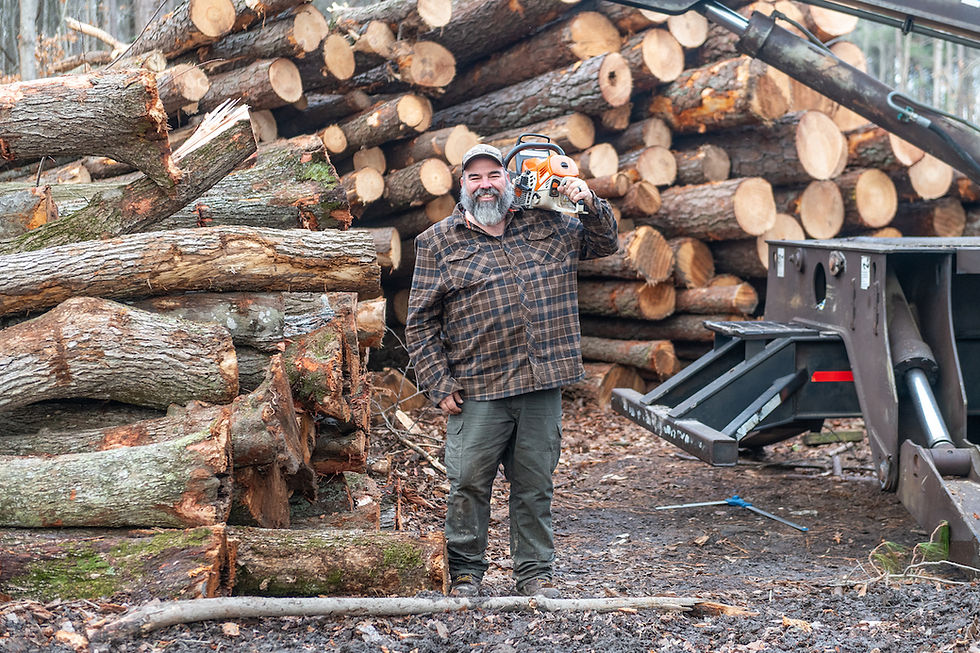
Meet Kenny Pusey, President of the Paul M. Jones Lumber Company. Kenny has steered the company through decades of adapting to markets, expanding capacity, and integrating new technology. He made sure I understood, though, that this is a family tale – Kenny works alongside his wife, Barbara, and sons, Hunter (General Manager) and Logan (Plant Manager). Hunter and Logan are fifth generation, a testament to the company’s values of family, quality, and sustainability. Let’s take a trip back in time to the first…
It all began in the late 1800’s. Picture this: teams of men wielding cross-cut saws, mules pulling felled trees through the forest, logs floating up the dark, winding waters of the Pocomoke River. In 1918, William H. Jones and Paul M. Jones, Sr., officially founded the company, solidifying everything that the father and son had already accomplished. They began to put down roots, occupying an office space in downtown Snow Hill, Maryland and a storage yard just up the road. In 1932, the company purchased a steam-powered portable sawmill, greatly increasing productivity. The mill moved from forest to forest processing felled trees into poles and pilings.
Providing materials for the 1939 World’s Fair in New York City pushed the limits of the company’s operations and introduced them to a wider market. Construction of buildings and boardwalks for the Fair required accessible, high-quality materials. Location gave the company a competitive edge – in two ways. First, proximity to the Northeast kept freight costs low. Second, southern yellow pine wood from the Delmarva Peninsula was, and continues to be, especially sought after for its density and strength (see the p.s.). The company thrived, and in 1948, the office, yard, and sawmill moved to its current location in Snow Hill. While loggers still went from forest to forest to harvest trees, now the mill was stationary.
After working at the company (and on the family farm) for most of his life, Paul M. Jones, Jr. officially took over operations from his late father in 1969. Paul, Jr. was passionate about the work, enough that all family vacations included stops at sawmills along the way. Barbara followed in her father’s footsteps, working in both the office and sometimes the yard; she married our protagonist, Kenny, in 1981. Kenny had worked summers at the company as a young man, and in 1984 started running the piling yard for his father-in-law. In late September of 1985, Hurricane Gloria destroyed Ocean City, Maryland’s iconic boardwalk. The company was called in to supply a portion of the pilings and decking needed for reconstruction. By opening day of the next tourist season, the boardwalk was ready. The company still supplies pilings as needed for the structure below, maintaining OC’s standard of being able to bear the weight of a fire truck (wow!).
Kenny stepped up after the passing of his father-in-law in 1991, running the company alongside Barbara and his mother-in-law, Helen. The addition of an advanced, computer-automated band saw the next year prompted a new level of efficient production. In the early 2000’s, the company expanded into the global market. Heavy timbers, 5” by 10” and 22’ or 28’ long, shipped to Egypt for mosque refurbishment projects in Western Asia. Beams, 12” by 12”, shipped to Spain for castle restoration projects in Europe. One restoration team reported that the quality and grain of the company’s wood best matched those of the existing, centuries-old exposed beams. To this day, wood products made from Delmarva trees cross oceans, headed to destinations such as the U.K. and Japan.
Kenny’s favorite part of the job is seeing the company grow and adapt, as it has for over a hundred years. With his guidance, the company continues to be a leader in the local, regional, and global heavy pine timber markets. Heavy timbers have always been the company’s specialty – think utility poles, foundation pilings, support beams; materials for bulkhead construction, infrastructure repair, and temporary structuring – not the types of wood you’d see at a hardware store.
So where does the tale go from here, you ask? While the future is always uncertain, Kenny and his son Hunter have a solid vision. The pair is always looking for ways to innovate, expand, and distinguish themselves from bigger mills to the south. As Hunter puts it, “if you aren’t changing and making things better, you aren’t going to be around.” These days, optimized technologies help machine operators determine the best position to cut based on the shape of a log and how to grade a product based on flaws. Kenny and Hunter continue to ensure that no part of the tree is wasted; from the sawdust to the stripped-off bark, all is put to use. Seems to me that those values – family, quality, and sustainability – ring true and stand the test of time. If our hunch is correct, this family will be a cornerstone in the forestry sector for generations to come.
p.s.
The Delmarva Peninsula lies at the northern extent of the range of southern yellow pine. This name encompasses four pine species – loblolly (Pinus taeda), longleaf (Pinus palustris), shortleaf (Pinus echinata), and slash (Pinus elliottii) – but most of the wood processed by the company is loblolly. Trees in this part of the range have a short growing period each year relative to the rest of the South, meaning that the growth rings are tighter. This creates wood with greater density and strength. The wood from southern yellow pines also accepts preservative treatment better than other species. Most of the company’s products go through a two-step finishing process. The first step is kiln-drying; this crystallizes the pine sap, making the product stronger and less susceptible to warping. The second step is an off-site preservative treatment; this extends the lifespan of the product by slowing down decay and inhibiting insect damage. Because of these factors, many of the company’s products receive a No. 1 grade from the structural engineers who inspect lumber nationwide.


Paul M. Jones Lumber has graciously opened its facility for tours focused on issues facing the forestry sector in Maryland. We thank them for being a willing partner and for sharing their knowledge, story, and expertise with thought leaders- being proactive rather than reactive can make a difference.
Photo Credit: Edwin Remsberg, Remsberg Inc.
Written By: Charly Sager, Natural Resource Planner- Maryland Forest Service
Project Support: Maryland DNR as part of the Delmarva Woodland Stewards Grant

LINKS TO LEARN MORE:
Paul M Jones Lumber is "Your Premier Source for Quality Timber Products on Maryland's Eastern Shore."
Maryland Forests Association, Inc. (MFA), is Maryland's voice for forest, wildlife, and natural resource management. The MFA website is a tool for learning about Maryland's issues related to forest resources, forest land ownership, forest management, and the forest products industry.
We believe that there's more to our forests than trees and that forest conservation is best accomplished through education, for ourselves and for all who benefit from our forest resources. Our "Faces of Forestry" public perception campaign aims to increase awareness and understanding of the benefits of sustainable forest management in Maryland. All of the profile stories can be found on our BLOG.
Maryland's Forests- Great for the Environment and the Economy
Why Join MFA?

Have you ever wondered what those stamps on lumber mean? Maybe this illustration will help. If you spot lumber with TP 128 as the mill number, you'll know it's high-quality wood from Paul M. Jones Lumber Company!

Click here to learn more about MFA's Faces of Forestry project.
If you are interested in becoming one of our "faces," contact Beth Hill at 410-463-1755



Comments